
Jinxiu (Sherry) Liang
Cameras and algorithms for scenes too fast or too dark to see.
I am a researcher at the National Institute of Informatics (NII) in Tokyo, Japan, hosted by Prof. Imari Sato. I work on physics-based vision for fast and faint scenes, funded by JSPS KAKENHI and an NII grant (both as PI).
Before NII, I was a postdoctoral fellow (2021–2025) with Prof. Boxin Shi at Peking University, working on low-light, high-speed photography with neuromorphic cameras. I received my Ph.D. (2021) and B.Eng. (2016) from South China University of Technology, advised by Prof. Yong Xu, and worked closely with Prof. Hui Ji and Prof. Yuhui Quan on optimization and image priors for inverse problems in low light.
Much of the work below was done jointly with students in these groups.
Email / Google Scholar / researchmap / DBLP / ORCID / GitHub / LinkedIn
News
- 2026.07 · EventUPS presented at ICCP 2026, Princeton.
- 2026.07 · Named a Gold Reviewer for ICML 2026 (top 25%) [list].
- 2026.06 · Poster and live demo at NII Open House 2026.
- 2026.06 · Named an Outstanding Reviewer for CVPR 2026 (top 5%) [list].
- 2026.04 · New JSPS KAKENHI project begins (PI).
- 2026.03 · COIL-PS published in Optics Express.
- 2025.12 · V2V presented at NeurIPS 2025: ordinary video turned into event-camera training data at scale.
- 2025.10 · EventUPS (Highlight) and SpikeDiff presented at ICCV 2025.
- 2025.06 · Poster and live demo at NII Open House 2025.
- 2025.06 · Active hyperspectral imaging with an event camera (Highlight) presented at CVPR 2025.
Research
Information is the resolution of uncertainty. — after Claude Shannon
In imaging terms: a camera captures new information only where the scene departs from what it already knows; the rest of every frame merely re-measures what it could have predicted. The waste is largest where imaging is hardest: fast motion, low light, or both.
So my imaging systems split the work three ways: sensors that record only change, optics that write physics into the timing of change, and generative priors that fill in the predictable rest.
I expect this economy to move imaging from expensive instruments into devices worn or carried to the scene.
My research interests, each with selected papers (full list):
Note: # equal contribution (co-first author); * (co-)corresponding author.
Neuromorphic sensing | Cameras that report change, not frames
Event cameras don't take pictures; each pixel fires the moment its brightness changes, with microsecond timing. Design the optics right, and each pixel's firing time encodes geometry, spectrum, lighting, or motion, measured continuously rather than frame by frame.
-
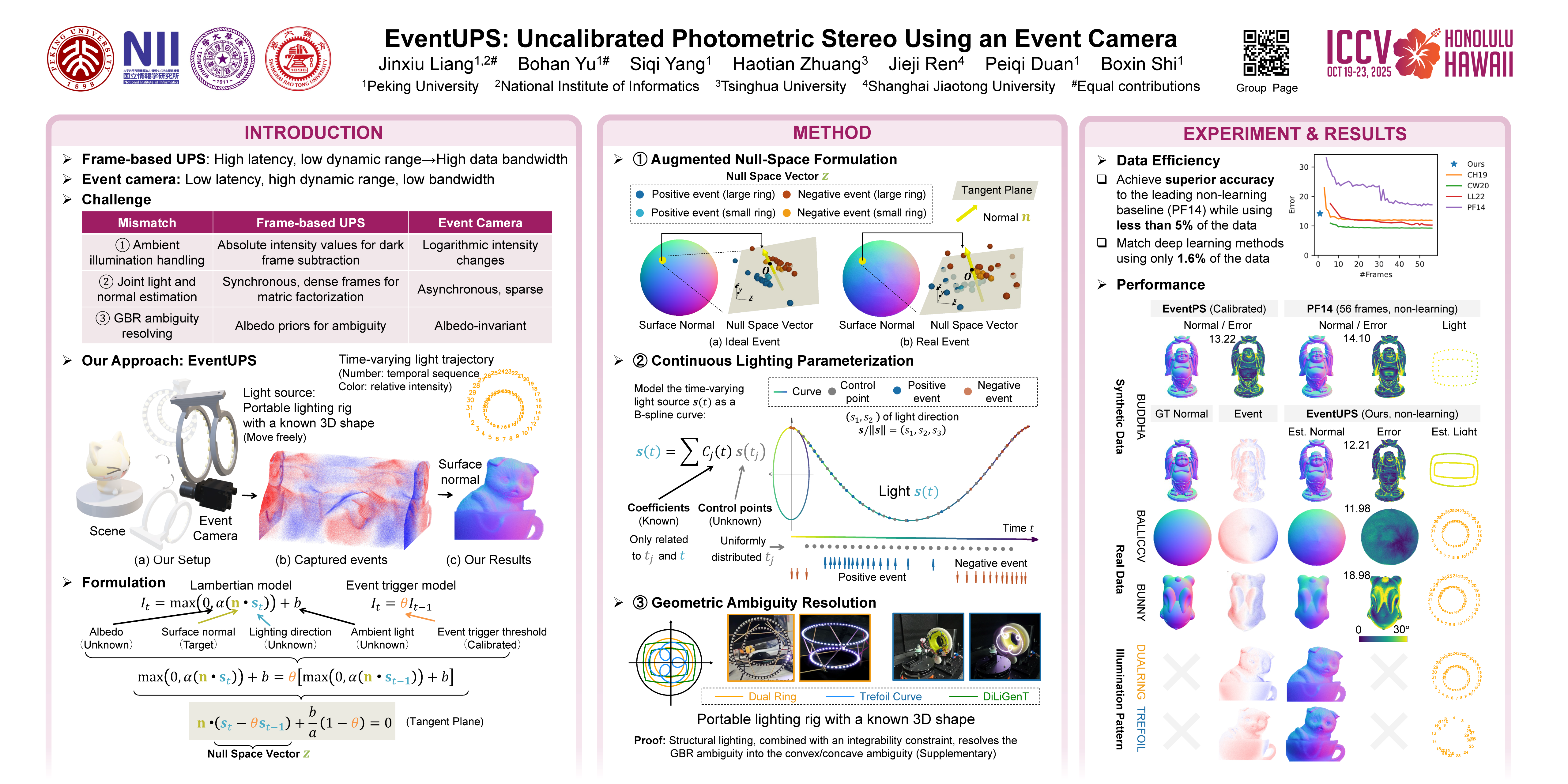
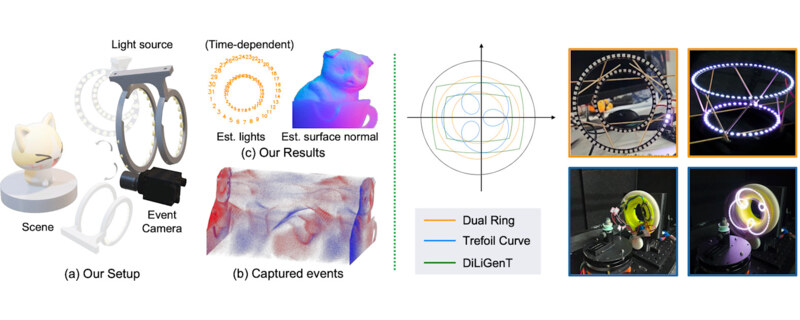 IEEE/CVF International Conference on Computer Vision (ICCV), 2025 (Highlight, top 3% of 11,239 submissions)Also presented at ICCP 2026.Lighting written into time: 3D surfaces recovered from an event camera under unknown, moving light, surpassing frame-based accuracy at 5% of the bandwidth.
 -
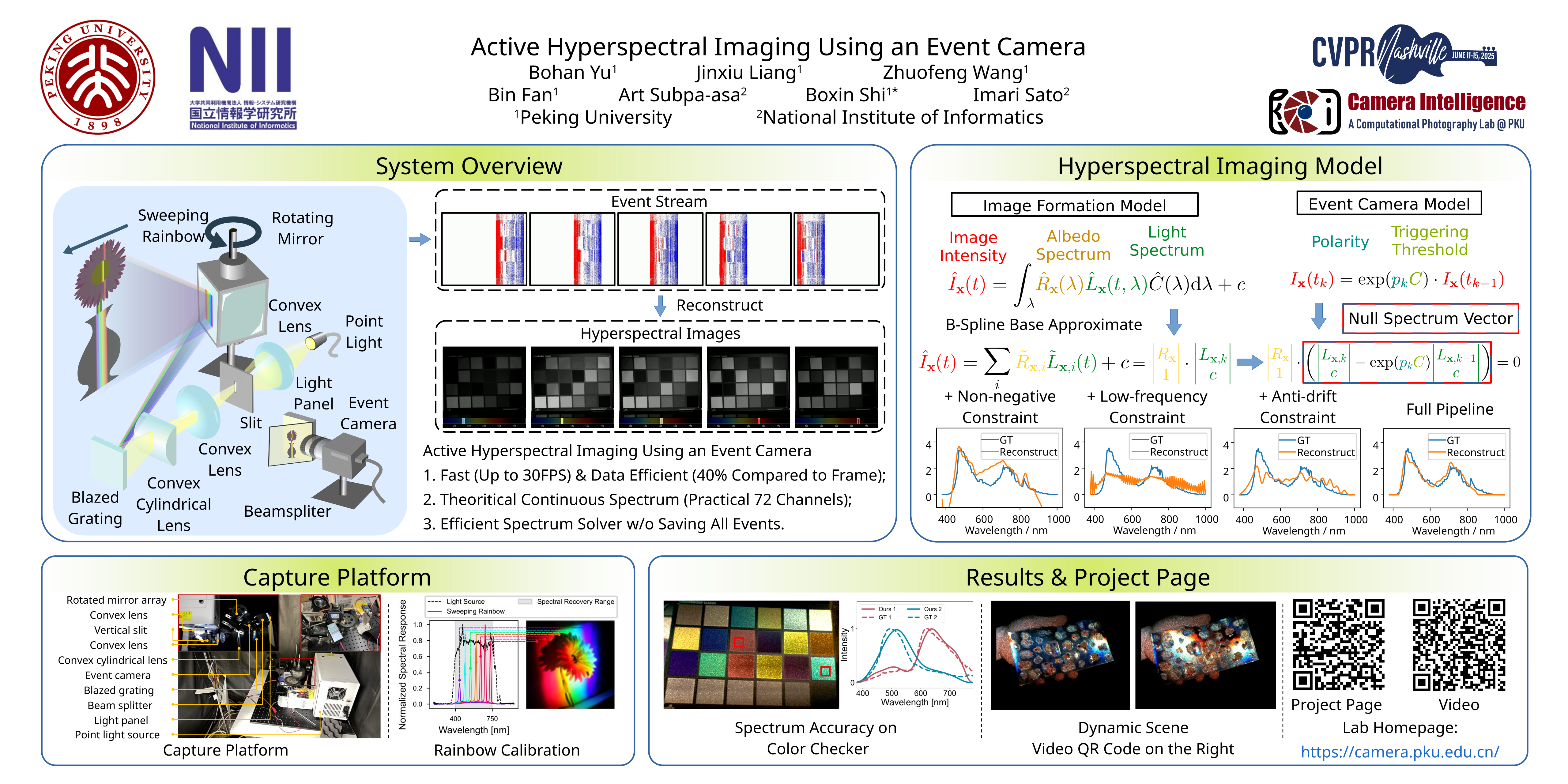
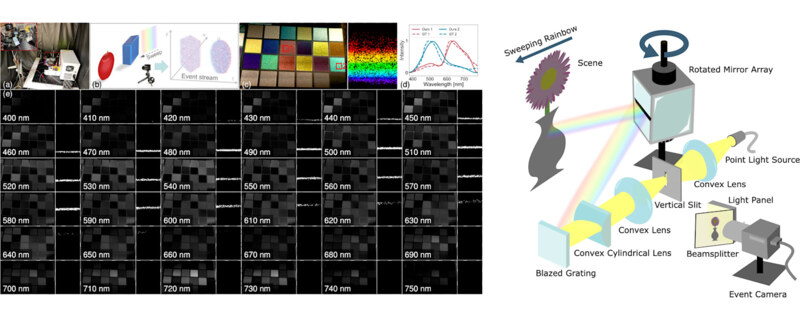 IEEE/CVF Conference on Computer Vision and Pattern Recognition (CVPR), 2025 (Highlight, top 3% of 13,008 submissions)A rainbow sweeps across the scene and each pixel’s firing time reveals its spectrum: hyperspectral video of dynamic scenes.
 -
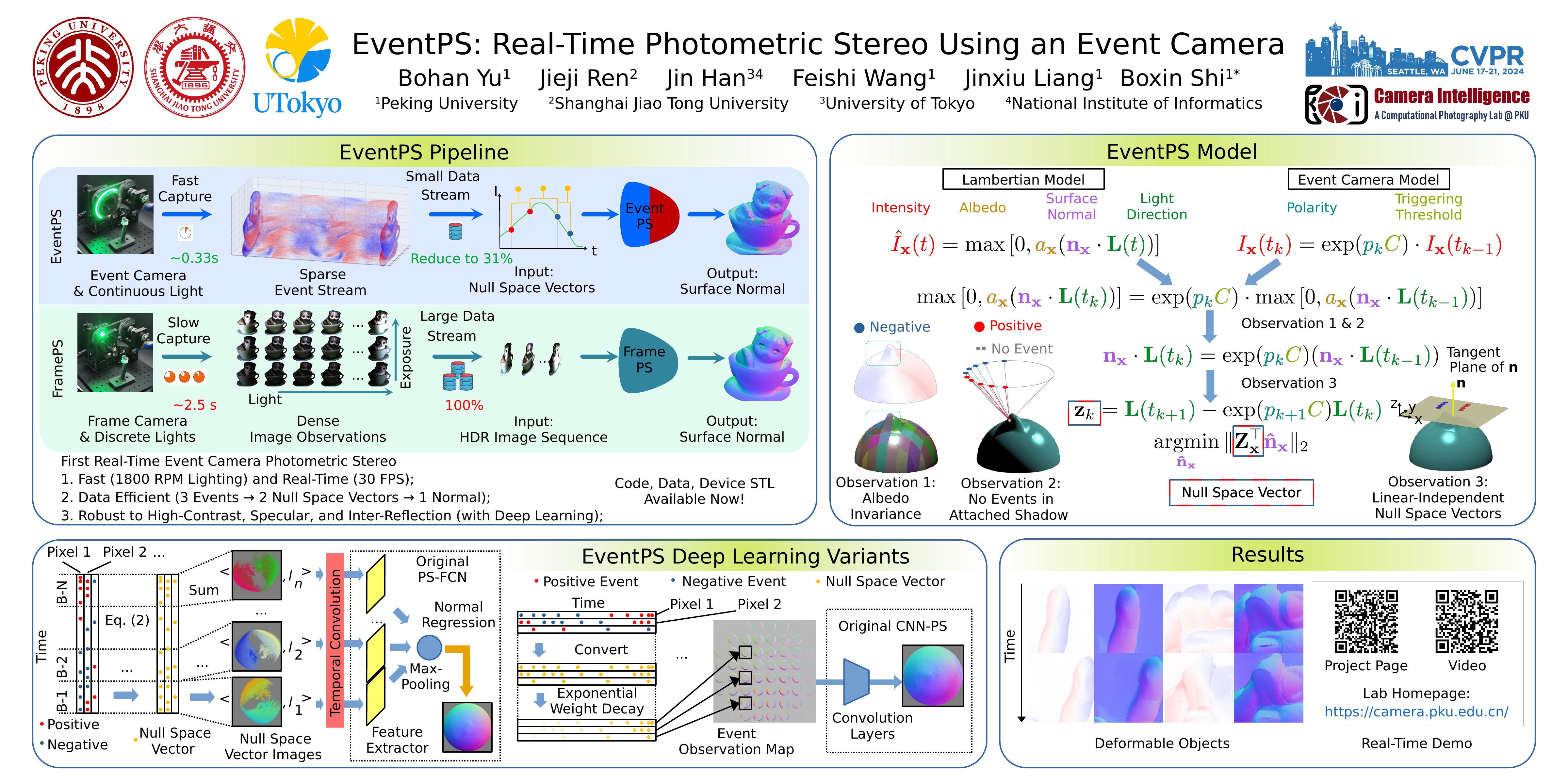
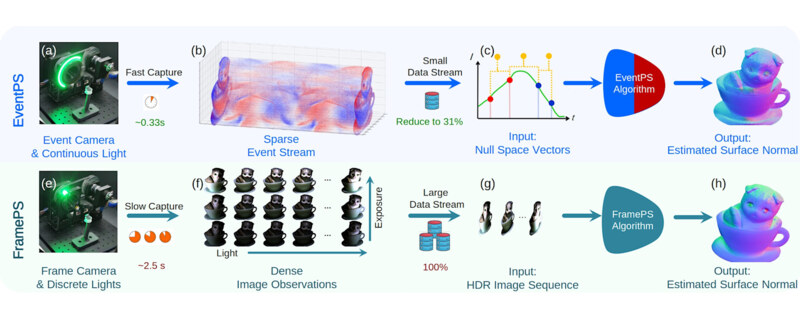 IEEE/CVF Conference on Computer Vision and Pattern Recognition (CVPR), 2024 (Best Paper Runners-Up, top 4 of 11,532 submissions)Surface shape from varying light, computed live with a single event camera: photometric stereo goes from offline pipeline to real-time sensor.


Zero-shot reconstruction | No paired data, no fine-tuning
Many measurements worth making (new sensors, rare events) will never have large paired training sets. So I build reconstruction that needs none: the prior comes from models pretrained on ordinary images, and the sensor's own physics keeps the result faithful to what was measured.
-
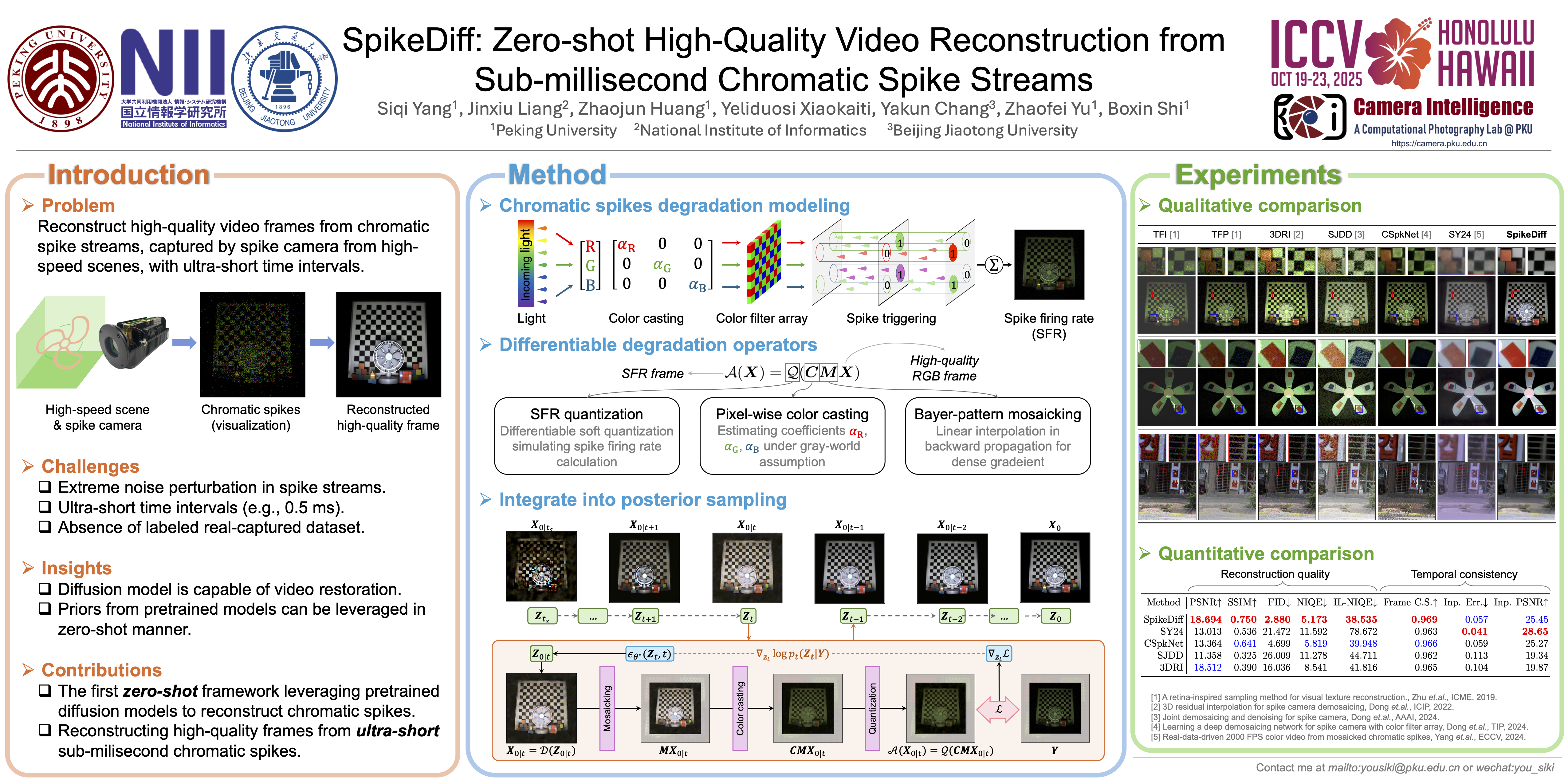
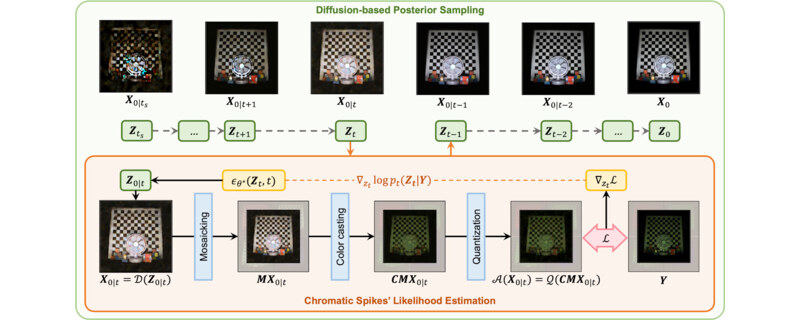 IEEE/CVF International Conference on Computer Vision (ICCV), 2025Color video of sub-millisecond motion, reconstructed from raw spike streams: no large training dataset exists for this camera, so sensor physics guides a pre-trained diffusion model instead.
 -
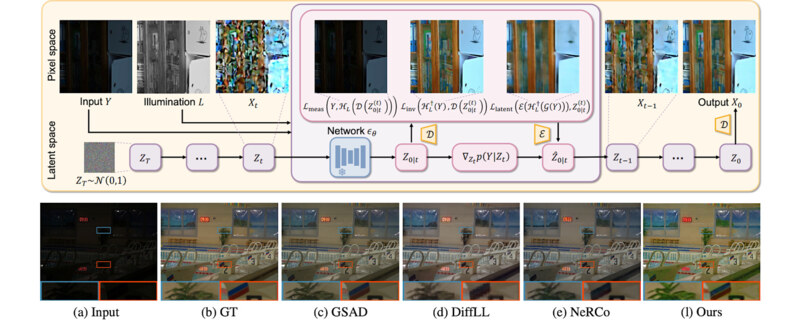 AAAI Conference on Artificial Intelligence (AAAI), 2025Severely underexposed photos restored with a pre-trained latent diffusion model as the only prior: no paired data, no fine-tuning.
 -
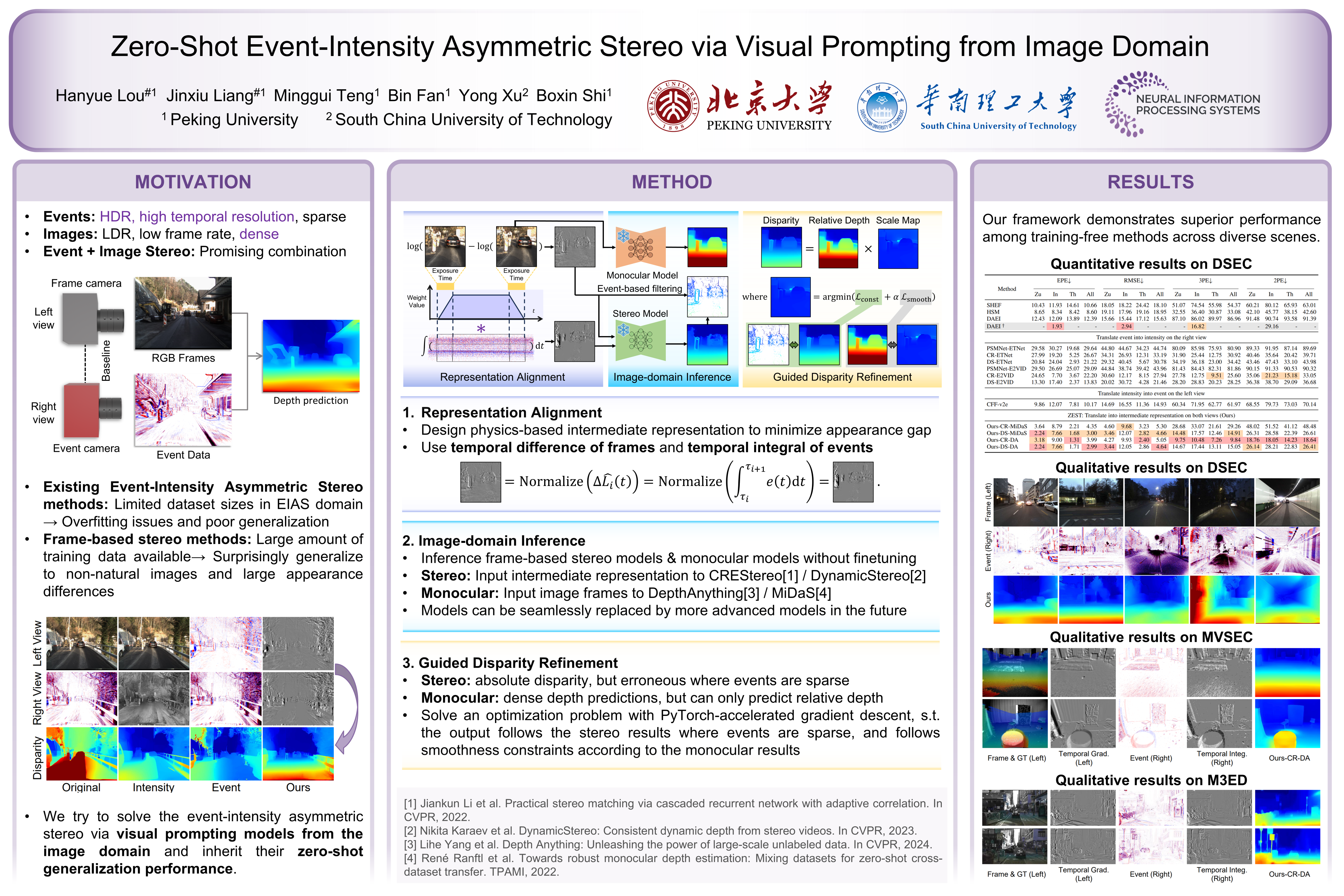
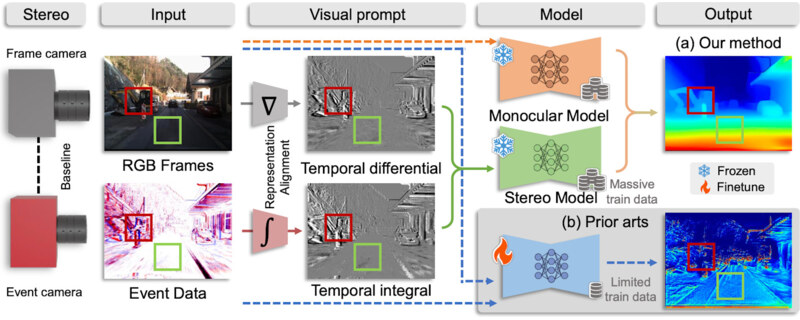 Advances in Neural Information Processing Systems (NeurIPS), 2024Depth from an event camera paired with a regular camera: events are rendered image-like so off-the-shelf vision models can match them, with no event-domain training.
 -
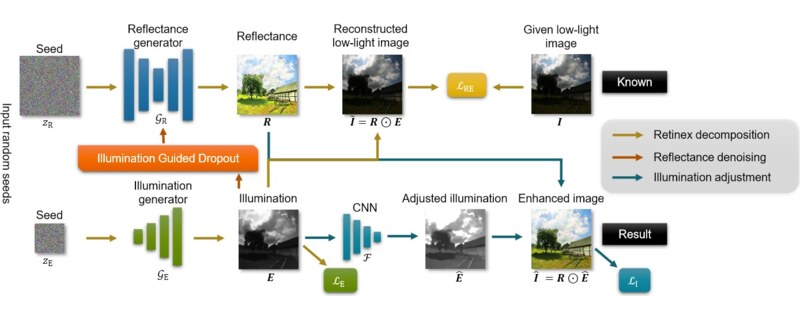 IEEE Transactions on Circuits and Systems for Video Technology (TCSVT), 2022Enhancement learned from nothing but the single input image, using untrained neural networks as priors.


Photon-limited vision | Low light, short acquisition time, or both
A dark scene and a fast one fail the same way: too few photons reach the sensor in the time available. I recover more from fewer photons and shorter acquisitions, from nighttime video to scientific measurement where physics caps the light budget (a delicate sample, a limited dose).
-
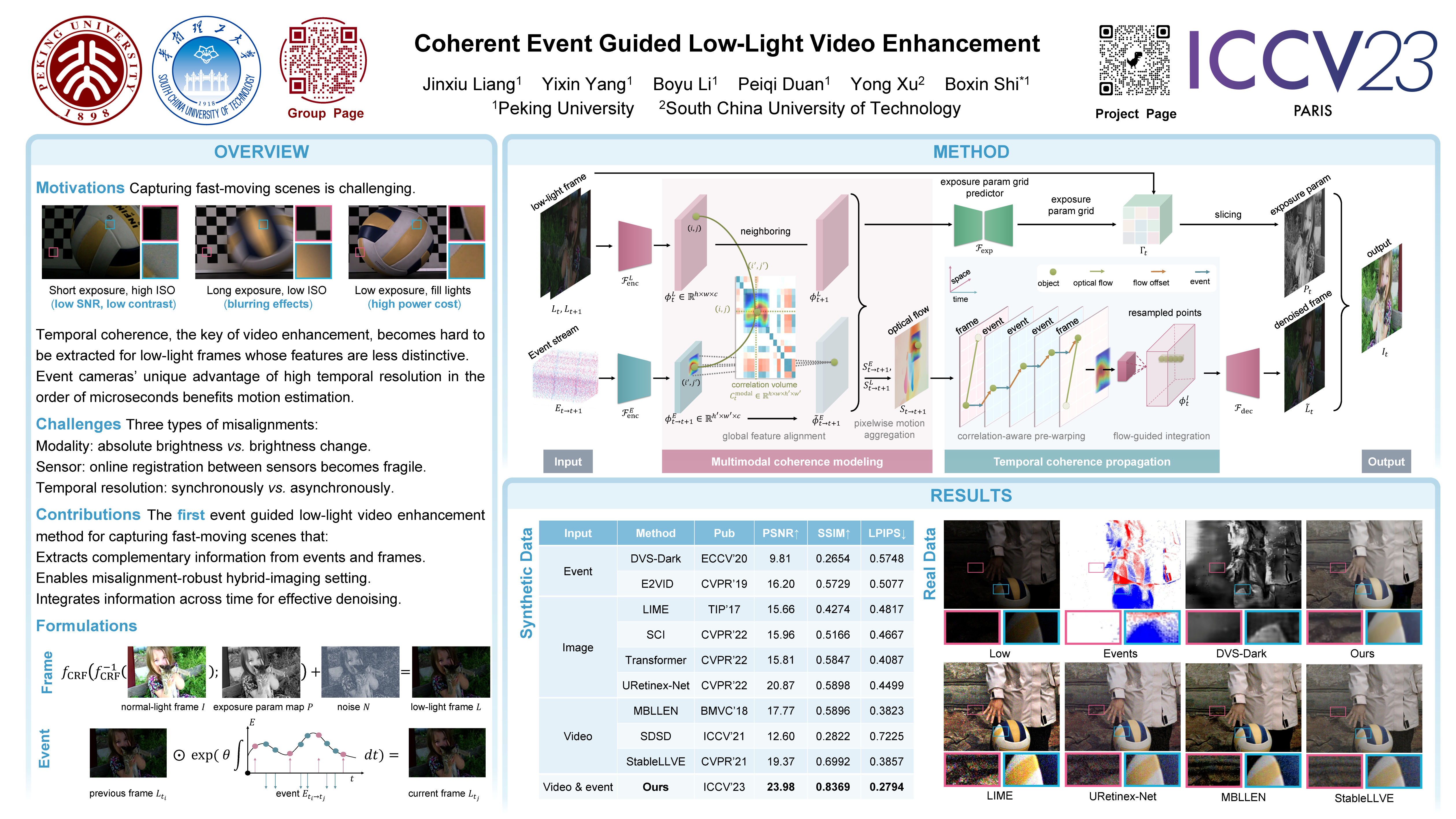
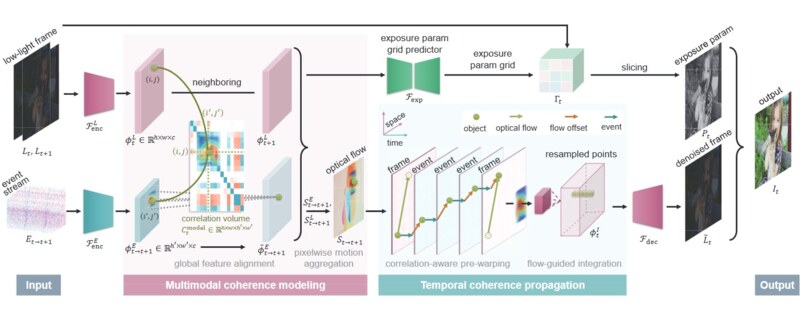 IEEE/CVF International Conference on Computer Vision (ICCV), 2023Fast and faint at once: dark, fast-moving video made bright, sharp, and temporally stable by fusing frames with events.
 -
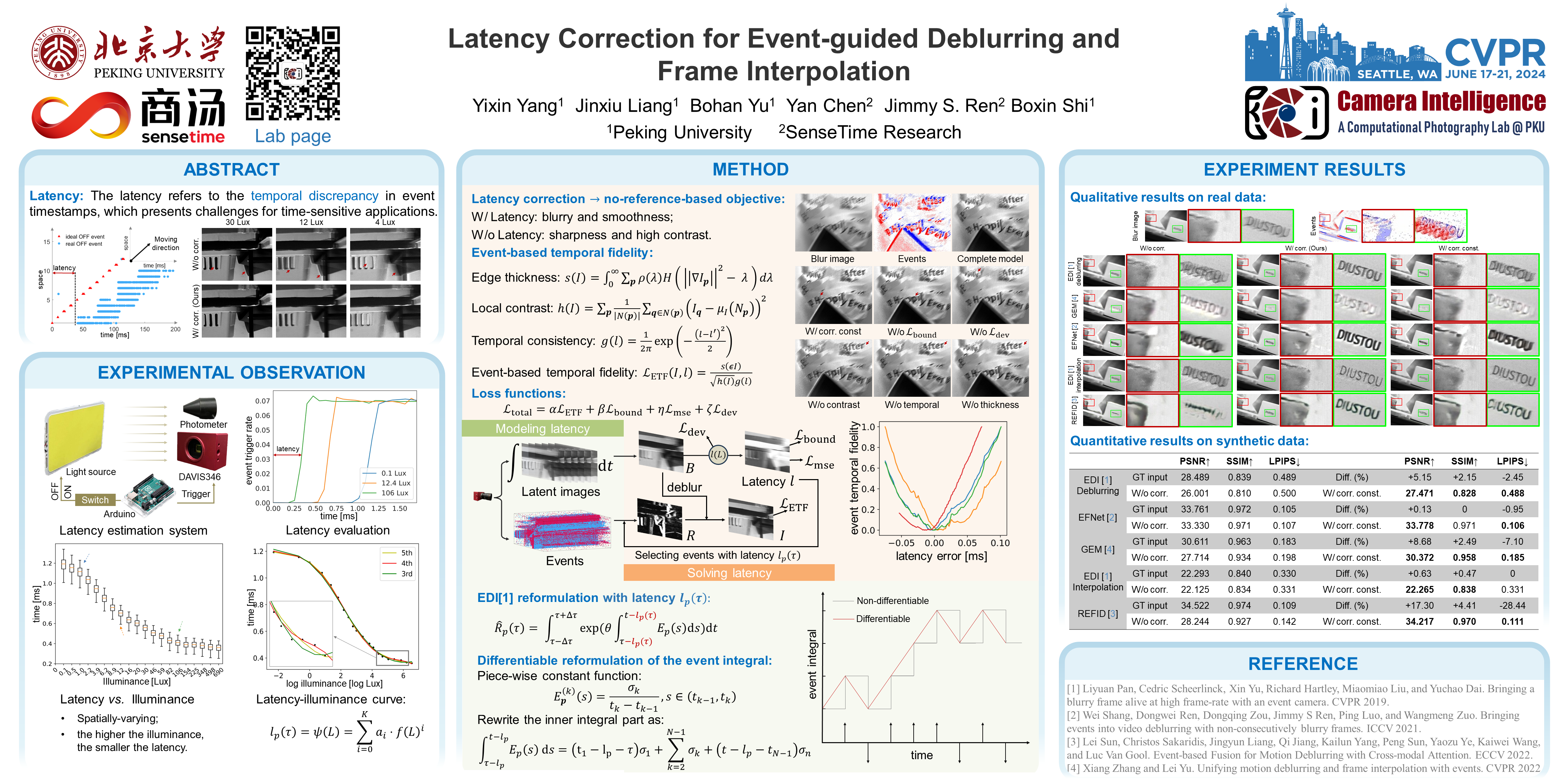
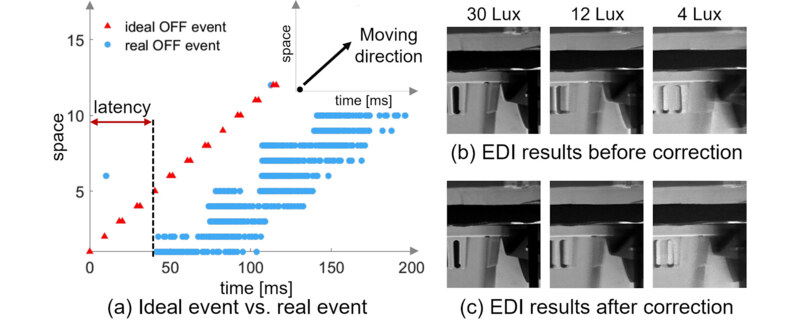 IEEE/CVF Conference on Computer Vision and Pattern Recognition (CVPR), 2024Modeling per-pixel latency makes event timestamps accurate where they drift most: in the dark.
 -
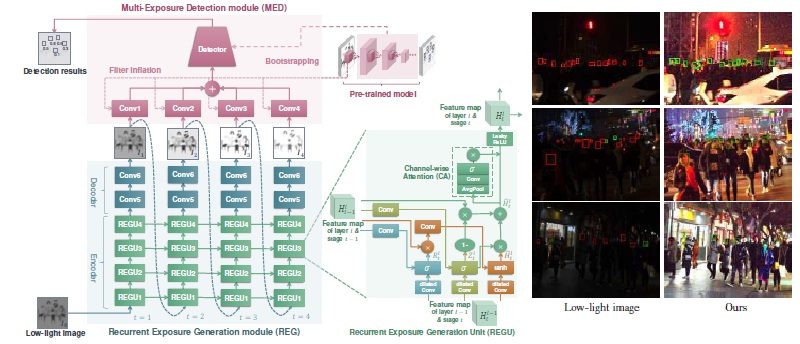 IEEE Transactions on Multimedia (TMM), 2021Face detection at night: the network imagines a series of brighter exposures from one dark photo, then detects across them.


Funding
As Principal Investigator:
- 2026 · Physics-Constrained Continuous Temporal Field Reconstruction from Asynchronous Event Streams for High-Speed Scene Analysis, JSPS KAKENHI Grant-in-Aid for Early-Career Scientists [record]
- 2025 · Generative Neuromorphic Photography for Low-Light High-Speed Scenarios, National Institute of Informatics, Japan
- 2023 · Key Technologies of Event-Guided Low-Light High-Speed Photography, National Natural Science Foundation of China (Young Scientists Fund)
- 2022 · Uncertainty Modeling for Image Enhancement in Real-World Low-Light Scenarios, China Postdoctoral Science Foundation
Awards
- 2024 · CVPR Best Paper Runners-Up [paper] [announcement] [tweet]
- 2020 · Second Prize of the Guangdong Provincial Science and Technology Progress Award [announcement]
Service
Recognition:
- 2026 · CVPR Outstanding Reviewer (top 5%) [list]
- 2026 · ICML Gold Reviewer (top 25%) [list]
- 2024 · NeurIPS Top Reviewer (top 8%) [list]
- 2023 · IJCV Outstanding Reviewer (1 of 4) [announcement]
Reviewing:
- Journal: IEEE TPAMI, IJCV, IEEE TIP, IEEE TMM, IEEE TCI, IEEE TCSVT, IEEE TIM, Information Fusion
- Conference: CVPR (2022–2026), ICCV (2023, 2025), ECCV (2022, 2024, 2026), NeurIPS (2024, 2025), ICML (2025, 2026), ICLR (2024), AAAI (2023, 2025, 2026)
Teaching and Outreach
- 2025–2026 · Presenter, NII Open House poster and demo [2025] [2026]
- Spring 2022–2025 · Guest Lecturer, Computational Photography, Peking University, Lecture 11 (Intrinsic Image Decomposition)
- Spring 2017–2020 · Teaching Assistant, Visual Computing, South China University of Technology
- Fall 2016–2020 · Teaching Assistant, Cryptography and Security Protocols, South China University of Technology
Miscellanea
- I grew up on science fiction, on scenes where something as light as a pair of glasses lets a person see what eyes alone cannot, and part of why I do research is the wish to move a few of those scenes into engineering.
- I spent my school years on math olympiads; I still love problems that refuse to yield.
- In my undergraduate years, I was elected (one of six, campus-wide) to help run my university’s student union, an early lesson in moving many people toward one goal.
- At home I report to Mangguo, whose low-light, high-speed vision needs none of my algorithms.
